

















An MVP in software development, or minimum viable product, is the earliest working version of your product that delivers real value to users and generates validated learning, with the least possible effort. It’s not the smallest thing you can ship. It’s the smallest thing you can ship that tells you whether the market actually cares.
Where traditional development bets everything on a complete product, an MVP front-loads the most important question: does this deserve to be built at all?
This guide covers everything you’d want to know about MVP in software development; from the three elements of a real MVP, how it compares to prototypes and proofs of concept, the different MVP types, feature prioritization, building for AI-powered products, success metrics with real benchmarks, and when to scale, pivot, or stop.
Let’s dig in.
The 3 Elements of a Real MVP: Minimum, Viable, Product
The word MVP gets misused because teams often focus only on the word minimum. In practice, all three parts matter equally.
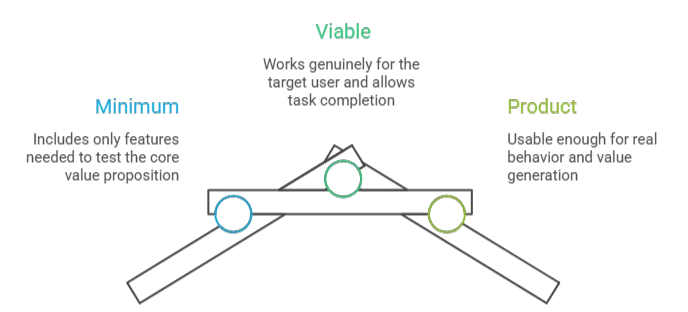
- Minimum means the product includes only the features required to test the core value proposition. If a feature does not help validate the main problem-solution fit, it should usually wait.
- Viable means the product must genuinely work for the target user. It cannot be a broken demo or a vague promise. If users cannot complete the core task, the product is not viable.
- Product means it has to be usable enough for real behavior to happen. People must choose to try it, understand it, and get value from it.
A product is only viable if it is valuable, usable, and feasible.
MVP Vs Prototype Vs Proof of Concept
These three terms get mixed together all the time when it comes to MVP development, but they solve different problems. Here’s how we can differentiate them:
| Format | Who it is for | Real users? | When to use it |
|---|---|---|---|
| Proof of Concept (PoC) | Internal team, architects, investors | No | To test if a technology or concept is technically feasible |
| Prototype | Stakeholders, testers, design reviews | Sometimes (partially) | To demonstrate flow, layout, or interactions and validate design ideas |
| MVP | Early adopters and real users | Yes | To validate market demand and see if people will actually use or pay for the product |
The table above shows the distinct roles of PoCs, prototypes, and MVPs in this journey, each answering a different question: Can it be built? How will it work? Will anyone use it? Understanding these distinctions naturally leads to the next layer of product thinking, where terms like MVP, MMP, and MMF define what to ship, test, and launch at each stage.
Let’s dig that up in the next section.
MVP, MMP, and MMF, what’s the difference?
Terms like MVP, MMP and MMF often surface when you’ve decided to go with an MVP, and confusing them is a surprisingly common (and costly) mistake. Before you consider building an MVP or look for a reliable mobile app development company, let’s ease this confusion:
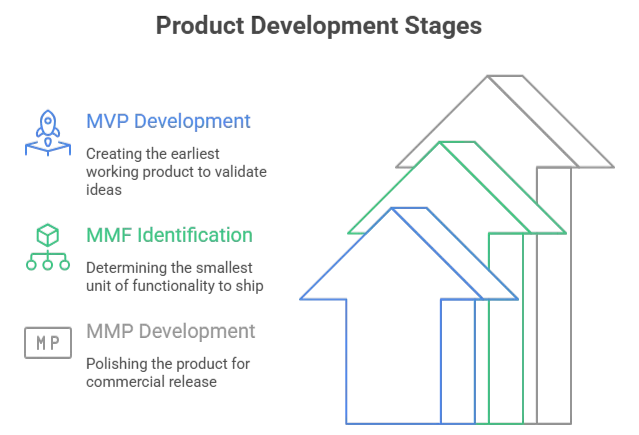
- MMF (Minimum Marketable Feature): The smallest unit of functionality worth shipping on its own. One problem, one solution, one release.
- MVP (Minimum Viable Product): The earliest working product that validates whether a core idea has demand. The goal is learning, not revenue.
- MMP (Minimum Marketable Product): The earliest version ready for commercial release, polished enough to retain users and stable enough to grow.
These formats represent different stages along the journey from idea to commercial product, but not every product needs all three. Some may only require one, while others benefit from the full sequence. Speak to an expert here for a free consultation to decide what your project idea needs.
There are times that even an MVP is not required. As much as it is important to know how to build an MVP and when to build one, it is equally important to know when not to build an MVP.
When Not to Build an MVP
Before choosing an MVP format, there’s an important strategic question many teams skip: should you build an MVP at all? In some cases, the smartest move is not a minimum viable product, but a prototype, discovery sprint, or phased production release.
Let’s explore when you may want to skip the MVP route:
- The problem is already proven internally: You already know the pain is real, the users are real, and the business case is not in doubt.
- The revenue path is obvious: You do not need to test whether people will pay. You already know how the product will make money.
- The workflow is contractually defined: This is common in enterprise software, internal platforms, and client-specific products where the process is already locked in.
- Compliance makes a “half-step” product unrealistic: In healthcare, fintech, or regulated environments, even a limited release may still need strong security, auditability, privacy controls, or legal review from day one.
In those cases, a better option may be:
- a discovery sprint
- a prototype
- a proof of concept
- a phased production build
The key question is simple: what is the real uncertainty?
- If the uncertainty is about market demand, an MVP is usually the right tool.
- If the uncertainty is about workflow design, stakeholder alignment, technical feasibility, or compliance readiness, another format may be smarter.
8 Types of MVPs in Software Development with Examples
Every MVP in software development serves a purpose, and the right format depends on what you need to validate first: demand, usability, pricing, technical feasibility, or operational flow.
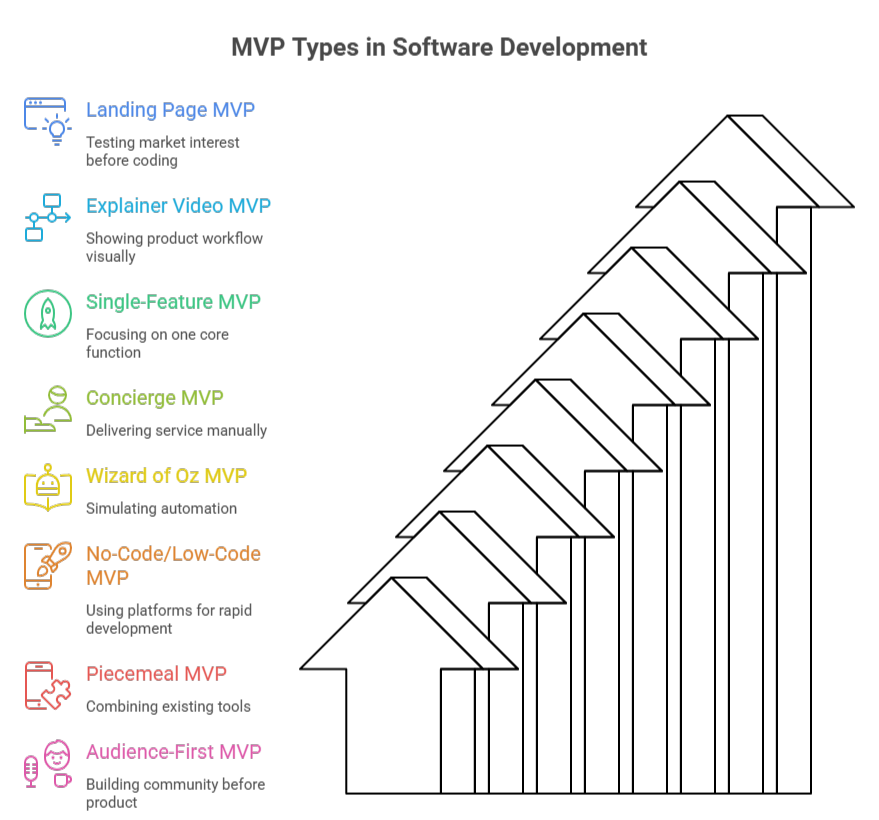
From a senior product and delivery perspective, choosing the right MVP type early can save months of unnecessary development and help you learn faster with less risk.
1. Landing Page MVP
A landing page MVP is one of the fastest ways to test market interest before writing code. It usually explains the product idea, highlights the main value proposition, and tracks actions like sign-ups, demo requests, or waitlist joins.
This type works best when you want to validate messaging, demand, or audience interest for a new product idea. It is especially useful in the pre-development stage, when the main question is not “can we build it?” but “will people care enough to act?”
2. Explainer Video MVP
An explainer video MVP shows how the product would work before the full product exists. It helps potential users understand the concept, the workflow, and the value in a simple visual format.
This approach is useful when the product is expensive, complex, or time-consuming to build and you want to test interest first. It works well for products with a new or unfamiliar concept where users need to “see it” before they can respond to it.
3. Single-Feature MVP
A single-feature MVP focuses on one core function exceptionally well, instead of trying to work on multiple areas without precision. The idea is to solve one painful problem extremely well and ignore everything that does not directly support that first use case.
This is often the best option for SaaS, mobile apps, or workflow tools where one strong feature can prove value quickly. It should be used when the team already has a clear hypothesis about the main user pain point and wants to test adoption around that one workflow.
4. Concierge MVP
In a concierge MVP, the service is delivered manually by people rather than through software automation. From the user’s point of view, they still get the promised outcome, but the backend process is human-powered.
This model is best when you want to validate the problem, the user journey, and willingness to pay before investing in engineering. It is especially useful for service-heavy products, AI-assisted workflows, marketplaces, or platforms where you still need to understand how the process should work in real life.
5. Wizard of Oz MVP
A Wizard of Oz MVP gives users the impression that the product is fully automated, even though some or most of the work is happening manually behind the scenes. Unlike a concierge MVP, the user interacts with what appears to be real software.
This is a smart option when you need to test user behavior in a software-like experience but do not want to build the full automation yet. It is commonly used when teams want to validate product experience, interface flow, or user trust before investing in complex backend systems.
6. No-Code or Low-Code MVP
A no-code or low-code MVP uses platforms like Bubble, Webflow, Glide, or similar tools to create a functional early product quickly. It is designed for speed, lower initial cost, and rapid iteration rather than long-term scalability.
This option is best when the workflow is relatively straightforward and the product does not require deep custom logic or heavy infrastructure at the start. It is ideal for early validation, founder-led testing, internal tools, and startup concepts that need quick market feedback.
7. Piecemeal MVP
A piecemeal MVP is built by combining existing off-the-shelf tools and services instead of creating a custom platform from scratch. For example, a team might use Airtable for data, Stripe for payments, Zapier for automation, and Notion or Webflow for the front end.
This type is useful when you want to test a business model or service flow with minimal engineering effort. It works particularly well for operationally simple startups that need to prove demand, pricing, or process efficiency before investing in custom development.
8. Audience-First MVP
An audience-first MVP is an action, not a product. It starts by building a niche community or user base before turning the strongest need into software. Instead of beginning with product features, you begin with direct access to the people who have the problem.
This is a strong choice when the market is still forming or when user pain points are not yet fully clear. It works well for founder-led startups, creator-driven products, and B2B ideas where trust, relationships, and repeated conversations reveal what the software should become.
Feature Prioritization Frameworks: MoSCoW and Kano with Worked Examples
Feature prioritization is where most MVP software design efforts either become disciplined or collapse into wish lists.
A simple way to scope or design an engineer-led expert MVP roadmap is to combine MoSCoW and Kano.
- MoSCoW sorts features into – Must have (M), Should have (S), Could have, and Won’t have now/Would like later (W)
- Kano helps you judge emotional value – by classifying features into ‘Basic expectations’ (must-haves), ‘Performance features’ (drive satisfaction proportionally), and ‘Delight features’ (unexpected bonuses that wow users).
Worked Example: B2B field-service scheduling SaaS
Imagine you are building software for companies that dispatch technicians.
| Feature | MoSCoW | Kano type | MVP decision |
|---|---|---|---|
| Job creation and assignment | Must | Basic | Include |
| Technician calendar view | Must | Basic | Include |
| SMS reminders | Should | Performance | Include if budget allows |
| Route optimization | Could | Performance | Delay |
| AI scheduling assistant | Could | Delight | Delay |
| Full analytics dashboard | Could | Performance | Delay |
| Payroll integration | Won’t now | Basic for later stage | Delay |
| Offline mode | Should | Basic in some industries | Include only if target users need it immediately |
The prioritization logic aligns closely with the 60/20/20 rule, a guideline popularized in product management circles for MVP feature planning. According to this framework, roughly 60% of your MVP features should be core “must-haves”, those essential for users to accomplish the primary job.
About 20% can be “should-haves”, improving efficiency or the overall experience, and the remaining 20% can be optional “delighters”, small touches that surprise and delight users but aren’t critical to validating demand.
From an expert perspective, this approach is highly practical. It ensures that your MVP is lean yet functional, prioritizing features that prove product-market fit while leaving room for iterative enhancement.
Most MVP builds fail in scoping, not development.
If you want a senior delivery perspective on your product idea before you commit a budget, we can help.
The AppVerticals VITAL Framework for Building an MVP
Most MVP builds don’t fail in development, they fail in scoping. Teams build the wrong things, measure the wrong signals, and call the result validated. The VITAL framework, strategized by Fahad Rehman, Lead Software Engineer and Solution Architect at AppVerticals, is a delivery lens designed to avoid exactly that.
- V — Validate the pain before a single feature is scoped. Confirm that the problem is significant enough that users will seek a solution and adopt a product to address it. Making assumptions here is the most common and costly mistake in early-stage development.
- I — Isolate the core flows. Focus on the minimal set of flows that prove your product’s value, not multiple journeys or personas. Everything else is a distraction until these flows work seamlessly.
- T — Trim to evidence-generating features. Keep only the features that validate user behavior or willingness to pay. If a feature doesn’t generate actionable signals for product decisions, it doesn’t belong in the MVP.
- A — Assemble the fastest viable stack. Build using the simplest architecture that is both secure and scalable. Speed is critical, but not at the expense of the ability to iterate and grow.
- L — Learn from usage, not opinions. Track activation, retention, conversion, and repeated use. What users do is far more reliable than what they say they would do.
This is where many MVP projects improve immediately. Once the team scopes around one measurable user outcome, feature creep becomes much easier to resist, because every proposed addition now has to answer the same question: does this help us learn faster?
If you want a detailed look at how to build an MVP, our guide includes a step-by-step process to guide you through.
Realistic MVP Timelines And Budget Ranges
In MVP delivery, scope is the main factor that drives timelines and budgets. Scope includes product type, team size, tech stack, and compliance requirements. Teams that manage scope carefully can hit predictable timelines, while uncontrolled scope is the main reason projects overrun.
| MVP type | Typical timeline | Common budget range | Key scope factors |
|---|---|---|---|
| Landing page / smoke-test MVP | 2–4 weeks | $5k–$15k | Copy, analytics, traffic setup |
| No-code web MVP | 4–8 weeks | $10k–$30k | Workflow complexity, integrations |
| SaaS web app MVP | 10–20 weeks | $35k–$100k | Auth, roles, dashboard, billing |
| Mobile app MVP | 10–16 weeks | $30k–$80k | Platforms, backend, onboarding |
| API-first / platform MVP | 12–24 weeks | $50k–$120k | Infrastructure, documentation, security |
| AI-powered MVP | 12–24+ weeks | $45k–$150k+ | Data quality, model selection, guardrails |
MVP Testing Strategies and User Research Methods
“Collect feedback” is not a strategy. Teams need structured validation.
The best MVP testing usually mixes five methods.
- Usability Testing: Identifies where users struggle and how intuitive your product flows are.
- Smoke Tests: Measures whether real demand exists by presenting a simplified offer (like a landing page or signup) before building the full product.
- Concierge Tests: Validate outcomes by manually delivering the service or solution to a few users, confirming that your product actually solves the problem and creates value.
- Wizard of Oz Testing: Simulates advanced product features behind the scenes, letting teams test complex behavior without fully building automation.
- A/B Testing: Compares variations of features or flows to see which performs better, but only effective once there’s enough traffic or usage to generate meaningful insights.
A senior project manager or business analyst from AppVerticals would usually tell a client this: do not ask ten people if they “like the idea.” Watch five target users try to complete the core action. Then look at whether any of them comes back on their own. That is far more useful than broad but shallow feedback.
Building an MVP for AI-powered products
AI changes MVP planning because your first release is no longer just software. It is software plus model behavior plus data quality plus risk controls.
There are five practical rules you should use for AI-first MVP software development:
- First, validate the workflow before the model. If users do not need the workflow, better prompting will not save the product.
- Second, start with one narrow AI job, not a general-purpose assistant.
- Third, define human review points early.
- Fourth, measure output quality with task-specific rubrics.
- Fifth, keep model-switching flexibility in your architecture.
For teams launching in the EU or serving regulated use cases, the AI Act’s risk-based approach matters. Some research and prototyping activity may sit outside strict deployment obligations, but once the product is placed into service, transparency, oversight, and data governance can become central requirements. High-risk use cases demand far more care than casual generative tools.
A useful practical concept here is the minimum viable dataset. In other words, what is the smallest, clean, and relevant body of examples that you need to validate that the AI feature is worth shipping? In AI MVP software engineering, bad data creates false confidence faster than bad code, leading teams to believe a feature works well when it actually doesn’t.
Industry-Specific MVP Playbooks
Healthcare MVPs
In healthcare, an MVP still needs to respect privacy, access controls, and data-handling rules. Even a limited pilot should be scoped so that protected health information is handled appropriately or avoided entirely in the earliest release where possible. Teams that ignore this often turn a fast MVP into an expensive rebuild.
Fintech MVPs
A fintech MVP should narrow its first release to one transaction flow, one compliance surface, and one risk model. Payments, identity checks, audit logs, fraud monitoring, and regional regulation can multiply complexity very quickly.
E-commerce MVPs
For commerce products, the smartest first version is rarely “build the whole store.” It is often one niche category, one acquisition channel, one payment flow, and one retention trigger such as replenishment, personalization, or bundles.
B2B SaaS MVPs
B2B SaaS MVPs need stronger workflow clarity than visual polish. If the product saves time, reduces errors, or improves reporting for a team with a painful recurring process, even a rough first version can succeed.
The broader lesson is that MVP in web development is not one-size-fits-all. The right MVP scope changes based on compliance, user risk, buying cycle, and operational complexity.
Enterprise MVP Vs Startup MVP: Key Differences
Enterprise and startup MVPs are often discussed as if they are the same. They are not.
Here’s how they are different:
| Aspect | Startup MVP | Enterprise MVP |
|---|---|---|
| Goal | Quickly test market demand and validate user needs; focus on learning over perfection. | Deliver a solution that works within complex systems, satisfies multiple stakeholders, and aligns with organizational standards. |
| Launch | Usually external, targeting early adopters for rapid feedback. | Often internal or to a controlled subset of customers to reduce operational risk. |
| Scope | Minimal features needed to prove value or demand; every feature generates actionable insights. | Must navigate procurement, security audits, legacy system integration, and governance; features balance value and compliance. |
| Advantages | High speed and flexibility; can pivot or iterate rapidly. | Can leverage existing infrastructure, customer access, data systems, and support channels, reducing some development effort. |
| Challenges | Must build traction from scratch; no existing systems or user base. | Slower timelines due to approvals and coordination; learning and iteration are more gradual. |
| Key Focus | Speed, experimentation, and validating core hypotheses. | Stability, integration, compliance, and multi-stakeholder alignment. |
Startups prioritize speed and rapid learning, while enterprises prioritize stability, compliance, and alignment within complex systems. Understanding these differences helps teams set realistic timelines, budgets, and expectations for MVP development.
MVP Success Metrics and KPIs with Actual Benchmarks
If you cannot define success, your MVP is just a smaller product, not a learning system.
Here is a practical benchmark framework that can be used for early MVPs.
| Metric | Why it matters | Healthy early signal |
|---|---|---|
| Activation rate | Shows users reached the core value moment | 20%–40%+ depending on product complexity |
| Day 7 retention | Tells you whether the product matters after novelty wears off | 15%–30%+ for many early products |
| Day 30 retention | Stronger signal of recurring value | 10%–20% consumer, 20%+ for recurring B2B workflows |
| Weekly Active Users/Monthly Active Users ratio | Indicates habit strength | 30%–50%+ for weekly-use products |
| Trial-to-paid conversion | Measures commercial pull | 5%–15%+ early, depending on price and audience |
| NPS or qualitative advocacy | Captures strength of user sentiment | 20+ is promising at MVP stage |
| Manual retention signal | Are users asking for it, chasing it, or tolerating rough edges? | Strong positive sign |
| MRR for B2B MVPs | Shows willingness to pay | Even $5k–$20k MRR can be meaningful if retention is solid |
The metrics you track in your MVP, activation, retention, WAU/MAU, and willingness to pay, directly inform your next move. Strong engagement signals point toward scaling, mixed signals suggest a pivot, and consistently weak metrics indicate it’s time to pause or kill the project. Below we discuss this in detail.
After The MVP: Scale, Pivot, or Kill: A Decision Framework
Once the MVP is in the market, the team needs a decision framework. Not a vague promise to “iterate,” but a disciplined call on what comes next.
| Signal | Scale | Pivot | Kill or pause |
|---|---|---|---|
| Activation | Strong and improving | Weak overall but strong in one segment | Persistently weak after multiple changes |
| Retention | Stable repeat usage | Repeat usage only after unnatural effort or in a different use case | Users do not return |
| Revenue or willingness to pay | Customers pay or clearly commit | Interest exists but pricing/value proposition feels off | No serious willingness to pay |
| User feedback | Requests expansion and deeper features | Users value a different problem than the one you built for | Indifference or confusion |
| Delivery economics | Supportable with current model | Useful but too manual or costly in current form | Unsustainable even at small scale |
| Strategic fit | Strong with business vision | Better opportunity adjacent to current one | Misaligned with business goals |
- Scale: Scale when the product repeatedly proves value to a defined audience. That usually means activation is healthy, retention is improving, and users are pulling the roadmap forward with real requests.
- Pivot: Pivot when the demand is real but the current framing is wrong. Maybe the buyer is different, the use case is narrower, or one feature matters far more than the rest.
- Kill or pause: Stop when the evidence stays weak despite real testing. If activation remains low, users do not return, and nobody is willing to pay, the most professional decision may be to cut losses.
When to Move From MVP to Full Product
The move from minimum viable product software to full product should happen when uncertainty drops and repeatability rises.
In practice, that means you have a clear user segment, a repeatable acquisition or sales pattern, stable engagement, recurring demand for adjacent features, and enough confidence that the next development dollars are going into growth rather than guesswork.
If you are still unsure what problem you truly solve, you are not ready for a full product. If you know exactly who it is for, why they stay, and what they will pay for next, you probably are.
What Investors Want To See From an MVP
Investors rarely care that you shipped version one. They care about what version one proved.
The strongest MVP story for fundraising combines four things: a painful problem, real usage, signs of retention, and disciplined capital efficiency.
Good investor-facing MVP evidence often includes early cohort retention, design partners converting into paying customers, strong user quotes tied to real workflows, and a roadmap shaped by observed behavior. A weak investor story is “we built many features.” A strong one is “we proved a narrow market will use this repeatedly and pay for the next step.”
Conclusion
The biggest mistake people make when discussing MVP in software development is treating it like a shortcut to a cheaper product. It is not. It is actually a faster path to evidence. A good MVP helps you learn whether the problem is urgent, whether the user journey works, and whether the product deserves more investment.
The best teams use MVPs to make better decisions about what to build next, what to remove, and when to change direction.
If you are ready to move from understanding MVPs to budgeting for one, cost depends on a handful of decisions you are probably already thinking about: scope, platform, team structure, and whether you need custom code or a no-code starting point. Those variables can move the number from $25,000 to $150,000+ depending on what your MVP actually needs to prove.
For a full breakdown by product type, team model, and development stage, read ‘How Much Does an MVP Cost in 2026’. It includes real cost ranges from products AppVerticals has shipped, not just industry averages.
Or, if you would like to know the build process step by step, this guide, ‘How to Build an MVP: A Practical Guide’ is the best way forward.
Ready to build an MVP that generates real evidence, not just a smaller product?
AppVerticals helps founders and product teams scope, build, and validate MVPs that move fast without building the wrong thing.